
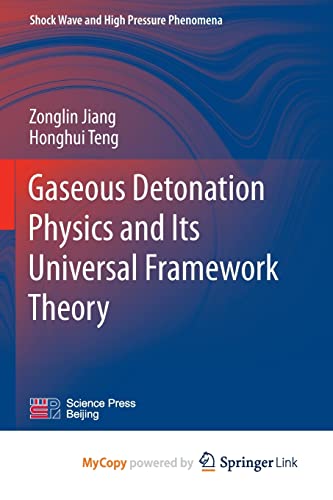
Gaseous Detonation Physics and Its Universal Framework Theory
R$324.24
Produtos relacionados



Todo mundo odeia um vencedor: aprenda como chegar ao topo e permanecer lá

Mais que um milionário: tudo o que aprendi com napoleon hill

Como ser um inútil e se tornar milionário: liberte-se do peso de suas tarefas diárias, compartilhe riquezas e voe mais alto

Napoleon hill meu mentor: como construí uma vida de riquezas com a mentoria de napoleon hill
Gaseous Detonation Physics and Its Universal Framework Theory –
Chap. 1 Introduction
1.1 Origin and cognition of gaseous detonation
1.2 Explosion, deflagration and detonation waves
1.3 Methodology of gaseous detonation research
1.4 Critical physical phenomena of gaseous detonation
Chap. 2 Mathematical equations and computational methods
2.1 Fundamental theories of gaseous detonation
2.2 Mathematical and physical models
2.3 Governing equations and computational methods
2.4 Multi-dimensional simulation of detonation and its analysis
Chap. 3 Classical theories of gaseous detonations and dynamic parameters
3.1 Chapman-Jouguet theory
3.2 Zel’dovich-von Neumann-Döring model
3.3 Weak initiation through deflagration to detonation transition
3.4 Direct initiation through strong ignition source
3.5 SWACER theory of weak and strong initiations
3.6 Dynamic parameters and its discussion
Chap. 4 Cellular detonation features and experimental observations
4.1 Multi-wave detonation fronts and cellular features
4.2 Structural evolution of propagating cellular detonation
4.3 Reflection and diffraction of cellular detonation
4.4 Bifurcation models of cylindrical cellular detonation
4.5 Propagation of irregular detonations
Chap. 5 Universal framework theory for initiation and propagation of regular gaseous detonation
5.1 Introduction
5.2 Physical mechanism of hot spot initiation
5.3 Combustion reaction zone and its evolution
5.4 Critical initiation state and characteristic parameters
5.5 Critical propagation state and statistical features of detonation cells
5.6 Averaged cell length and half-cell rule
5.7 Ignition delayed time and its correlation with cell length
5.8 Application of universal framework theory
5.9 Remarks on universal framework theory
Chap. 6 Structures and stationary rules of oblique detonations
6.1 Conservation laws and polar analysis of oblique detonations
6.2 Initiation structure of wedge-induced oblique detonation waves
6.3 Multi-wave structures and surface instability
6.4 Oblique detonation waves in realistic inflow conditions
6.5 Effects of rear expansion wave derived from finite-length wedges
6.6 Effects of blunt body on the initiation
Chap. 7 Engineering applications of gaseous detonation phenomena
7.1 Thermal analysis of detonation-based combustion process
7.2 Propulsion technologies based on detonation waves
7.3 Gaseous detonation driven high-enthalpy shock tunnels
Especificação: Gaseous Detonation Physics and Its Universal Framework Theory
|
1 avaliação para Gaseous Detonation Physics and Its Universal Framework Theory
Seja o primeiro a avaliar “Gaseous Detonation Physics and Its Universal Framework Theory”
R$324.24

Não existe nenhuma avaliação ainda.